The holiday cookie swap was in twelve hours and I’d completely forgotten. Everyone else would be bringing those elaborate, perfectly piped gingerbread houses and those French macarons that look like they belong in a bakery window. I had a jar of sourdough starter that needed feeding and a bag of rosemary that was starting to look a little sad in the crisper drawer. Honestly, I almost just grabbed a bottle of wine and called it a day. But then I remembered this rosemary sourdough focaccia I’d been tinkering with, the one that uses up a ton of starter and takes maybe ten minutes of actual hands-on work. I mean, it was a gamble. Focaccia at a cookie swap? But I was out of options, so I mixed the dough, let it do its thing while I panicked about what to bring, and threw it in the oven right before I had to leave.
When I walked in with this golden, herb-flecked bread, still warm from the oven and smelling like garlic and olive oil, people actually stopped talking. Seriously. My neighbor Karen, who spends three days on her biscotti, asked for the recipe before she even tried a piece. And then she tried it, and she asked again, more forcefully this time. It was one of those moments where you’re trying to play it cool, but inside you’re thinking, “Wait, this actually worked?” The rosemary sourdough focaccia was gone in twenty minutes. I had people asking me if I catered. Me! The person who showed up with a bread I’d thrown together out of sheer desperation.
That’s the thing about this recipe. It’s not fancy. It’s not fussy. It’s just really, really good bread that happens to look like you spent all day on it. The sourdough gives it this incredible tangy depth that you just don’t get with regular yeast bread, and the rosemary makes it feel special enough for a holiday table. Maybe you’ve been there, scrambling for something to bring at the last minute. This is the recipe you need. It’s the one that makes you look like a hero when you barely did any work.
Why You’ll Love This Recipe
Let me tell you why this rosemary sourdough focaccia is about to become your new holiday secret weapon. I’ve tested this recipe about a dozen times now, tweaking the hydration, playing with fermentation times, and figuring out exactly how to get that perfect, airy crumb with those crispy, crackly edges. This is the version that works every single time.
- Minimal Hands-On Time: The dough does all the work. You’re looking at maybe 10 to 15 minutes of active effort. The rest is just waiting, and waiting is something you can do while wrapping presents or watching a Christmas movie.
- Uses Up Extra Starter: If you keep a sourdough starter, you know the struggle of having too much discard. This focaccia uses a generous amount, so it’s perfect for that pre-holiday feeding frenzy.
- Naturally Impressive: That golden, dimpled surface with fresh rosemary and flaky salt? It looks like it came from a fancy bakery. No one needs to know it came from your regular kitchen with minimal effort.
- Perfect for Any Holiday Gathering: This works as an appetizer with dips, as a side for soups and stews, or just as a bread basket star. It’s versatile enough for Thanksgiving, Christmas, or New Year’s Eve.
- Better the Next Day: Honestly, this focaccia might be even better on day two. The flavors meld together, and the texture stays incredible. It’s the kind of bread you’ll find yourself sneaking bites of at 11 p.m.
What makes this different from every other focaccia recipe out there? It’s the sourdough starter. That tangy, complex flavor is something you just can’t replicate with commercial yeast. Plus, the long, cold fermentation in the fridge develops a texture that’s chewy and tender at the same time. It’s comfort food that feels elevated, but it’s really just simple ingredients treated with a little patience.
This is the recipe that makes you close your eyes after the first bite. It’s the one that gets passed around the table with murmurs of approval. And it’s the one you’ll make again and again, not just for holidays, but for any day you want to feel like you’ve got your act together.
What Ingredients You Will Need
This recipe uses simple, mostly pantry-staple ingredients to create something that tastes far more complex than it should. The magic is in the fermentation and the quality of your olive oil. Here’s what you need:
- Bread Flour: 500 grams (about 4 cups). I prefer King Arthur brand for its consistent protein content, which gives the best structure. All-purpose flour works in a pinch, but bread flour gives that chewier, more authentic focaccia texture.
- Active Sourdough Starter: 200 grams (about 1 cup), bubbly and fed within the last 4 to 6 hours. This is the heart of the recipe. If your starter is sluggish, your focaccia will be too. I like to feed mine the night before so it’s nice and active in the morning.
- Warm Water: 375 grams (about 1 1/2 cups), around 80°F (27°C). Not too hot, or you’ll kill the good bacteria. Think warm bath water, not hot tea.
- Extra Virgin Olive Oil: 60 grams (about 1/4 cup) for the dough, plus at least 2 tablespoons for the pan and another 2 tablespoons for the top. Use a good quality oil here—it’s a major flavor component. I love California Olive Ranch for a reliable, fruity option.
- Fine Sea Salt: 10 grams (about 2 teaspoons). Don’t skimp. Salt is crucial for flavor and for controlling fermentation.
- Fresh Rosemary: 2 to 3 tablespoons, finely chopped. Fresh is non-negotiable here. Dried rosemary is too woody and sharp. Look for rosemary that’s bright green and fragrant, not sad and wilted.
- Flaky Sea Salt: For finishing, like Maldon. That crunchy, salty pop on top is what makes this focaccia addictive.
- Optional Toppings: Thinly sliced garlic cloves (about 4 to 6), cracked black pepper, or a sprinkle of red pepper flakes for heat.
For the best flavor, I recommend using a starter that’s been well-maintained. If you’re new to sourdough, don’t worry. Even a younger starter will work here; it might just need a little more time to rise. You can also add a pinch of commercial yeast if your starter is feeling sluggish, but honestly, the whole point is that tangy sourdough flavor, so try to let the starter do its thing.
If you’re out of bread flour, all-purpose is fine. The texture will be slightly less chewy, but it’ll still be delicious. For a whole wheat version, substitute up to 150 grams of the bread flour with whole wheat flour. You’ll need a bit more water, as whole wheat absorbs more liquid.
Equipment Needed
You don’t need a lot of fancy gear for this rosemary sourdough focaccia. That’s part of the beauty. But there are a few things that make the process easier and the results better.
- Large Mixing Bowl: Glass or ceramic is ideal. Plastic works too, but avoid metal bowls, as they can react with the fermenting dough. I use a big Pyrex bowl that’s seen better days but still does the job.
- Digital Kitchen Scale: This is non-negotiable for sourdough. Measuring flour by volume is too inconsistent. A $15 scale from Amazon will change your baking life. I promise.
- 10×15-Inch Sheet Pan or 9×13-Inch Baking Dish: A standard half-sheet pan gives you that classic, low, wide focaccia shape. A 9×13 dish makes it a bit thicker. Both work great; just adjust the baking time slightly.
- Bench Scraper or Dough Scraper: For handling that sticky, high-hydration dough. It’s a game-changer. You can use a plastic one or a metal one. I prefer metal for cutting through the dough cleanly.
- Plastic Wrap or a Shower Cap: For covering the dough during its long rise. A reusable shower cap is my secret weapon—it fits perfectly over a mixing bowl and doesn’t waste plastic.
- Instant-Read Thermometer: Optional but helpful for checking water temperature and doneness. The focaccia is done when it reaches 200°F internally.
If you don’t have a sheet pan, a cast-iron skillet works beautifully. You’ll get a rounder, thicker focaccia with amazing crispy edges. Just adjust your expectations on shape. Also, don’t stress if you don’t have a bench scraper. A flexible spatula or even a well-floured hand works in a pinch.
Preparation Method

Alright, let’s make some bread. This process is spread out over a couple of days, but the actual work is minimal. Plan to start this about 24 hours before you want to serve it.
- Feed Your Starter (Day Before): The night before you plan to mix the dough, feed your sourdough starter. I do 50 grams of starter, 100 grams of flour, and 100 grams of water. Let it sit at room temperature overnight. By morning, it should be bubbly, doubled in size, and smell pleasantly sour.
- Mix the Dough (Morning of Day 1): In your large mixing bowl, combine 500 grams of bread flour and 10 grams of fine sea salt. Whisk them together to distribute the salt. In a separate measuring cup, combine 375 grams of warm water and 200 grams of your active, bubbly starter. Stir until the starter is mostly dissolved. Pour the wet ingredients into the dry ingredients and mix with a dough scraper or your hands until a shaggy, sticky dough forms. It will look a mess. That’s normal. Add 60 grams of olive oil and mix again until it’s incorporated. The dough will be very sticky and loose. Cover the bowl with plastic wrap and let it rest for 30 minutes.
- Perform Stretch and Folds (First 2 Hours): This is where you build strength without kneading. Every 30 minutes for the next 2 hours, perform a set of stretch and folds. Wet your hand slightly, grab one side of the dough, stretch it up, and fold it over the top. Rotate the bowl 90 degrees and repeat. Do this 4 times total, so you’ve folded each side. The dough will become smoother and more elastic with each set. After 2 hours (4 sets of folds), the dough should feel stronger and hold its shape a bit better.
- Bulk Fermentation (6 to 8 Hours at Room Temperature): Cover the bowl tightly and let it sit at room temperature (around 70°F to 75°F) for 6 to 8 hours. The dough should puff up, become bubbly, and almost double in size. It should feel airy and alive. If your kitchen is cold, it might take longer. If it’s hot, check it earlier. You’re looking for a dome-shaped top with small bubbles visible on the surface.
- Cold Fermentation (Overnight in the Fridge): This is the secret to deep flavor. Cover the bowl tightly and place it in the refrigerator for at least 12 hours, and up to 24 hours. The dough will continue to ferment slowly, developing that signature sourdough tang. The cold also makes the dough much easier to handle.
- Prepare the Pan (Day 2, 3 to 4 Hours Before Serving): The next day, take the dough out of the fridge. Generously coat your 10×15-inch sheet pan with 2 tablespoons of olive oil. Use your fingers to spread it all over the bottom and up the sides. Turn the cold dough out onto the oiled pan. It will be stiff and cold. Don’t try to stretch it yet. Just plop it in the center. Drizzle another tablespoon of olive oil over the top of the dough. Cover the pan tightly with plastic wrap and let it sit at room temperature for 1 hour. This allows the dough to warm up and relax.
- Stretch the Dough (After 1 Hour): After an hour, the dough will have softened slightly. Using your fingertips, gently press and stretch the dough toward the edges of the pan. It will resist and try to snap back. That’s okay. Stretch it as far as it will go without tearing, then cover it again and let it rest for another 30 minutes. Repeat this stretch-and-rest process one or two more times until the dough fills the pan evenly. Be patient. It will get there.
- Final Proof (1.5 to 2 Hours): Once the dough fills the pan, cover it and let it proof at room temperature for 1.5 to 2 hours. It should become puffy, jiggly, and full of air. You’ll see large bubbles forming on the surface. About 30 minutes before the proof is done, preheat your oven to 450°F (230°C) with a rack in the middle.
- Dimple and Top (Right Before Baking): This is the fun part. Generously drizzle another tablespoon or two of olive oil over the surface. Dip your fingertips in the oil, then press straight down into the dough, creating deep dimples all over the surface. Don’t be shy. You want those wells to catch the oil and rosemary. Sprinkle the chopped fresh rosemary evenly over the top. Press the thin garlic slices into some of the dimples if you’re using them. Finish with a generous sprinkle of flaky sea salt.
- Bake (25 to 30 Minutes): Place the pan in the preheated oven. Bake for 25 to 30 minutes, rotating the pan halfway through. The focaccia is done when it’s deep golden brown on top and sounds hollow when you tap the bottom. If you have a thermometer, the internal temperature should be around 200°F (93°C).
- Cool (The Hardest Part): Let the focaccia cool in the pan for 5 minutes. Then, carefully transfer it to a wire rack. Don’t skip this, or the bottom will get soggy. Let it cool for at least 20 minutes before slicing. I know it smells incredible, but patience pays off here. The texture sets as it cools.
Cooking Tips & Techniques
I’ve made this rosemary sourdough focaccia at least fifteen times, and I’ve learned a few things the hard way. Let me save you some trouble.
Don’t skip the cold fermentation. I once tried to rush this and did the whole thing at room temperature. The flavor was flat. That overnight stay in the fridge is where the magic happens. It develops that complex, tangy sourdough character that makes this bread special. It also makes the dough way easier to handle. Trust the process.
Use enough oil. This is not the time to be stingy with your olive oil. The focaccia needs that generous coating to get those crispy, almost fried edges. I once tried to cut back on the oil for a “healthier” version, and it was a dry, sad disappointment. The oil is part of the recipe. Embrace it.
Dimple with confidence. The first time I made focaccia, I barely pressed my fingers in, worried I’d deflate the dough. The result was a flat, uninteresting top. You want those deep wells. Press all the way down to the bottom of the pan. Those pockets catch the oil and create those irresistible crispy bits. It’s the best part.
Watch your hydration. This is a high-hydration dough, around 75%, which means it’s sticky. Don’t be tempted to add more flour to make it easier to handle. That stickiness is what gives you that open, airy crumb. Use wet hands and a bench scraper, and you’ll be fine. If you’re struggling, just chill the dough for 15 minutes. Cold dough is less sticky dough.
One of my biggest failures? I forgot to preheat the oven once. I put the focaccia in a cold oven and turned it on, thinking it would be fine. It was not fine. The rise was terrible, and the texture was dense and gummy. Always, always preheat. That initial blast of heat is what gives you the oven spring.
For consistent results, use a scale. I know it’s an extra step, but flour volume is so variable. One person’s “cup” can be 20% more than another’s. A scale eliminates that guesswork. My focaccia got consistently better the day I stopped using measuring cups.
Variations & Adaptations
This recipe is a fantastic base for experimentation. Here are some of my favorite twists.
Herb and Garlic Medley: Swap half the rosemary for fresh thyme and a teaspoon of dried oregano. Add a tablespoon of roasted garlic, mashed into a paste, and swirl it into the dough during the final dimpling. It’s incredibly aromatic and perfect with a bowl of tomato soup.
Caramelized Onion and Gruyère: While the dough is doing its final proof, slowly caramelize two large onions in butter and a splash of balsamic vinegar. Once the focaccia is dimpled and oiled, scatter the onions and a generous handful of grated Gruyère cheese over the top. Bake as directed. The cheese gets crispy and the onions get sweet and jammy. It’s a meal in itself.
Everything Bagel Focaccia: After dimpling and oiling, sprinkle the top with everything bagel seasoning (sesame seeds, poppy seeds, dried garlic, dried onion, and salt). It’s a brunch dream. I made this for a New Year’s Day brunch once, and it disappeared in minutes.
Sun-Dried Tomato and Feta: Chop 1/2 cup of oil-packed sun-dried tomatoes and crumble 1/2 cup of feta cheese. Press them into the dimples along with the rosemary. The salty, tangy feta pairs beautifully with the sourdough.
Gluten-Free Adaptation: This is tricky with sourdough, but possible. Use a gluten-free flour blend that contains xanthan gum. You’ll need to adjust the hydration, as gluten-free flours absorb liquid differently. Start with 400 grams of water and add more if needed. The texture will be denser and less airy, but the flavor will still be wonderful.
I once tried a version with chopped kalamata olives and a sprinkle of za’atar. It was a little too salty for my taste, but my friend who loves briny flavors devoured the whole pan. Don’t be afraid to experiment. Focaccia is forgiving.
Serving & Storage Suggestions
This rosemary sourdough focaccia is at its absolute best served warm, within an hour of coming out of the oven. The edges are still crispy, the interior is soft and pillowy, and the olive oil and rosemary are singing together. It’s a thing of beauty.
For a holiday table, I like to serve it as a showstopper appetizer. Place the whole focaccia on a large wooden board. Set out small bowls of good olive oil for dipping, maybe one with balsamic vinegar and another with cracked black pepper. A dish of marinated olives and some good salami or prosciutto on the side, and you’ve got a spread that looks effortless but feels special.
It also makes an incredible side dish. Serve it alongside a hearty winter soup like minestrone or butternut squash soup. It’s perfect for sopping up the last bits of broth. For a main course, it’s fantastic with a simple roasted chicken or a big salad with shaved Parmesan and lemon vinaigrette.
Storage: If you have leftovers (which is rare, but it happens), store them in an airtight container or a paper bag at room temperature for up to 2 days. Do NOT refrigerate it. The fridge will dry it out and ruin the texture. The bread will soften slightly, but it will still be delicious.
Reheating: The best way to revive leftover focaccia is to pop it in a 350°F (180°C) oven for 5 to 7 minutes. It will crisp right back up. You can also toast it in a toaster oven or even a dry skillet. Avoid the microwave unless you’re okay with a rubbery texture.
Freezing: This focaccia freezes beautifully. Let it cool completely, then wrap it tightly in plastic wrap, followed by a layer of aluminum foil. Freeze for up to 3 months. To thaw, let it come to room temperature on the counter, then reheat in the oven. The flavor is almost as good as fresh.
One thing I love about this bread is that the flavors actually improve on the second day. The rosemary and olive oil meld together, and the sourdough tang becomes more pronounced. It’s a great make-ahead option for holiday entertaining.
Nutritional Information & Benefits
Let’s be real—this is bread made with olive oil and salt. It’s not health food, but it does have some redeeming qualities. Here’s a rough estimate for one serving (about 1/8th of the full recipe):
- Calories: Approximately 280
- Total Fat: 12 grams
- Saturated Fat: 2 grams
- Carbohydrates: 36 grams
- Fiber: 2 grams
- Protein: 6 grams
- Sodium: 400 milligrams
The sourdough fermentation process actually has some benefits. The long fermentation breaks down some of the gluten and phytic acid, which can make the bread easier to digest for some people. The olive oil provides healthy monounsaturated fats, and rosemary is a good source of antioxidants. It’s not a salad, but it’s a more nutritious option than many store-bought breads.
This recipe is vegetarian and can be made dairy-free easily (just skip any cheese variations). It contains gluten, so it’s not suitable for celiacs unless you use the gluten-free adaptation. The sodium content is moderate, but you can reduce it by using less flaky salt on top.
For me, the nutritional value of this bread is as much about the experience as the numbers. It’s about sharing something handmade at a holiday table. It’s about the smell of rosemary and olive oil filling your kitchen. That counts for something, too.
Conclusion
This rosemary sourdough focaccia is more than just a recipe. It’s the bread that saved me from showing up empty-handed to a holiday party. It’s the bread that made my neighbor ask for the recipe twice. It’s the bread that makes you look like you’ve got it all figured out, even when you’re scrambling at the last minute.
The best part is how forgiving it is. You don’t need to be a professional baker. You don’t need fancy equipment. You just need a little patience and a willingness to get your hands messy. The sourdough does the heavy lifting, and the rosemary makes it feel special. It’s the kind of recipe that becomes a tradition, the one people request year after year.
I’d love to hear how it turns out for you. Did you try a variation? Did you serve it with something amazing? Drop a comment below and let me know. And if you loved it, share it with a friend who needs a last-minute holiday hero. Trust me, they’ll thank you.
Happy baking, and here’s to making something beautiful with whatever you’ve got in the kitchen.
Frequently Asked Questions
Can I use dried rosemary instead of fresh?
I really don’t recommend it. Dried rosemary has a much more intense, almost piney flavor, and the texture can be woody and unpleasant. Fresh rosemary is softer and has a more floral, aromatic quality that works perfectly with the olive oil and sourdough. If you’re in a pinch, use about half the amount of dried, and crush it between your fingers to release the oils.
My dough is incredibly sticky. What am I doing wrong?
Nothing! This is a high-hydration dough, which means it’s supposed to be sticky. That stickiness is what creates the open, airy crumb. Resist the urge to add more flour. Use wet hands or a lightly oiled bench scraper to handle it. If it’s really giving you trouble, pop the bowl in the fridge for 15 to 20 minutes. The cold will make it much easier to manage.
Can I make this without a sourdough starter?
You can, but it won’t have the same tangy flavor. If you want to use commercial yeast, substitute the 200 grams of starter with 100 grams of water and 100 grams of flour, plus 1/4 teaspoon of active dry yeast. The texture will be similar, but the flavor will be milder. Honestly, the sourdough is what makes this recipe special.
Why didn’t my focaccia get those big airy bubbles?
A few things could be at play. Your starter might not be active enough—make sure it’s bubbly and doubled before you use it. Your dough might not have fermented long enough during the bulk rise. Or you might have been too aggressive when stretching it into the pan. Be gentle and patient. The bubbles will come.
Can I half this recipe?
Absolutely. Cut all the ingredients in half and use a smaller pan, like an 8×8-inch baking dish or a 9-inch cast-iron skillet. The baking time will be slightly shorter, so start checking at around 20 minutes. It’s perfect for a smaller gathering or if you just want a little treat for yourself.
Pin This Recipe!
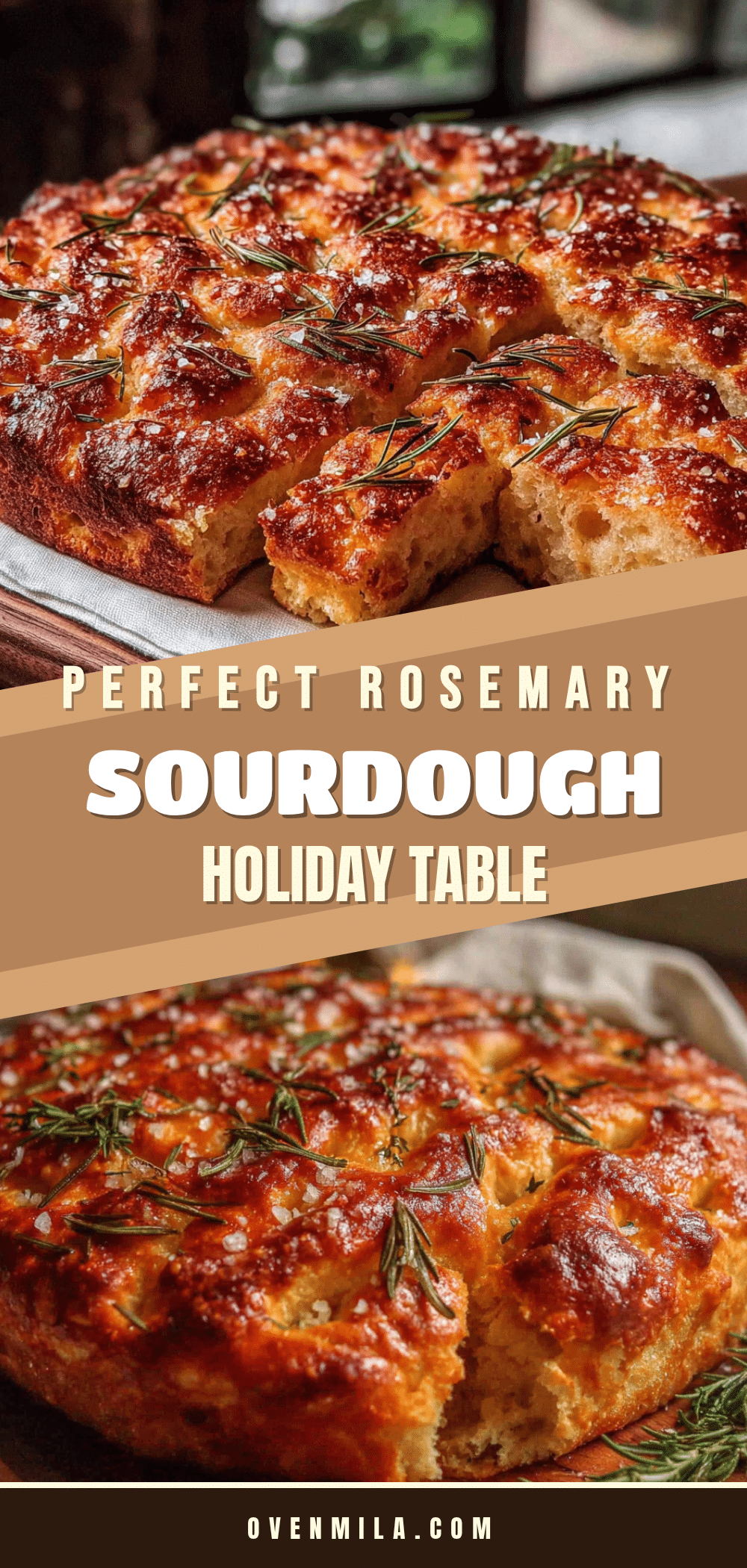
Perfect Rosemary Sourdough Focaccia: Best Holiday Appetizer

This rosemary sourdough focaccia is a showstopper holiday appetizer that requires minimal hands-on time. With a tangy sourdough depth, crispy edges, and fresh rosemary, it’s the perfect last-minute bread that looks like you spent all day on it.
- Prep Time: 15 minutes
- Cook Time: 30 minutes
- Total Time: 24 hours (includes fermentation and proofing)
- Yield: 8 servings 1x
- Category: Appetizer
- Cuisine: Italian
Ingredients
- 500 grams bread flour (about 4 cups)
- 200 grams active sourdough starter (about 1 cup), bubbly and fed within 4-6 hours
- 375 grams warm water (about 1 1/2 cups), around 80°F (27°C)
- 60 grams extra virgin olive oil (about 1/4 cup), plus at least 4 tablespoons more for pan and topping
- 10 grams fine sea salt (about 2 teaspoons)
- 2 to 3 tablespoons fresh rosemary, finely chopped
- Flaky sea salt (like Maldon) for finishing
- Optional: 4-6 thinly sliced garlic cloves, cracked black pepper, or red pepper flakes
Instructions
- Feed your starter the night before: mix 50g starter, 100g flour, and 100g water. Let sit at room temperature overnight until bubbly and doubled.
- In a large mixing bowl, whisk together 500g bread flour and 10g fine sea salt.
- In a separate measuring cup, combine 375g warm water and 200g active starter. Stir until mostly dissolved.
- Pour wet ingredients into dry and mix with a dough scraper or hands until a shaggy, sticky dough forms. Add 60g olive oil and mix until incorporated. Cover and rest 30 minutes.
- Perform stretch and folds every 30 minutes for 2 hours (4 sets total). Wet your hand, stretch one side of dough up and fold over top, rotate bowl 90°, repeat 4 times.
- Cover bowl tightly and let bulk ferment at room temperature (70-75°F) for 6-8 hours until doubled and bubbly.
- Cover and refrigerate for at least 12 hours and up to 24 hours for cold fermentation.
- Next day, generously coat a 10×15-inch sheet pan with 2 tablespoons olive oil. Turn cold dough out onto pan. Drizzle 1 tablespoon olive oil over top. Cover with plastic wrap and let sit 1 hour at room temperature.
- After 1 hour, gently press and stretch dough toward edges of pan. Cover and rest 30 minutes. Repeat stretch-and-rest 1-2 more times until dough fills pan evenly.
- Cover and let proof at room temperature for 1.5-2 hours until puffy and jiggly. Preheat oven to 450°F (230°C) with rack in middle during last 30 minutes.
- Drizzle 1-2 tablespoons olive oil over surface. Dip fingertips in oil and press straight down into dough to create deep dimples all over.
- Sprinkle chopped rosemary evenly over top. Press garlic slices into dimples if using. Finish with generous sprinkle of flaky sea salt.
- Bake for 25-30 minutes, rotating pan halfway through, until deep golden brown and hollow when tapped. Internal temperature should reach 200°F (93°C).
- Cool in pan 5 minutes, then transfer to wire rack. Cool at least 20 minutes before slicing.
Notes
Don’t skip the cold fermentation—it develops the tangy sourdough flavor. Use enough olive oil for crispy edges. Dimple with confidence, pressing all the way to the bottom of the pan. This is a high-hydration dough (about 75%), so it will be sticky—resist adding more flour. Always preheat the oven for proper oven spring. For best results, use a kitchen scale for accurate measurements.
Nutrition
- Serving Size: 1/8 of recipe
- Calories: 280
- Sodium: 400
- Fat: 12
- Saturated Fat: 2
- Carbohydrates: 36
- Fiber: 2
- Protein: 6
Keywords: sourdough focaccia, rosemary focaccia, holiday appetizer, sourdough bread, easy focaccia, homemade bread, Christmas appetizer, Thanksgiving bread